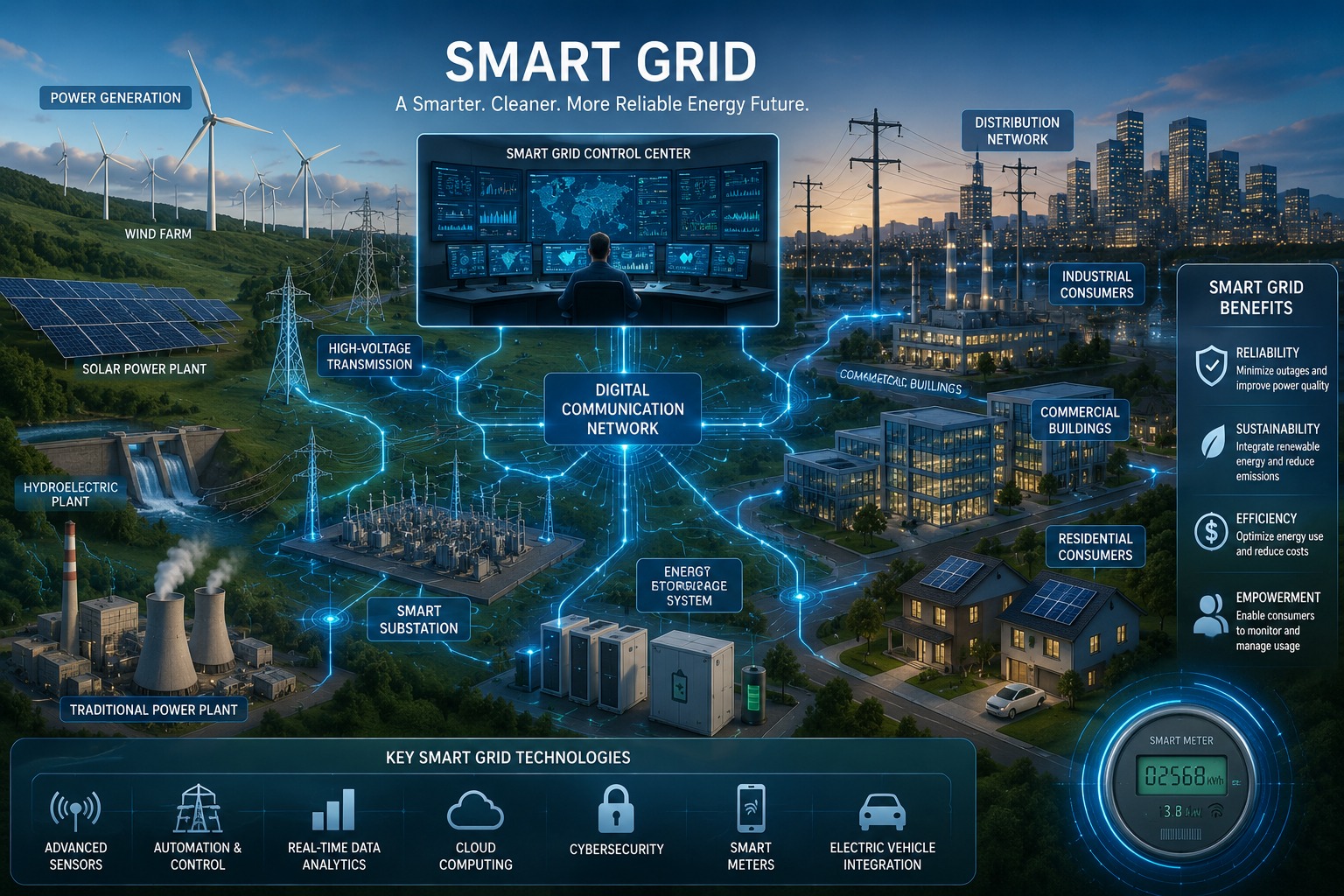
From Power Lines to Intelligent Networks: The $198 Billion Grid Revolution
The global smart grid market is entering a transformational investment cycle, evolving from a utility modernization initiative into the digital backbone of next-generation energy infrastructure.
Trend Analysis
With industry revenue projected to surge from $70.12 billion in 2025 to $198.2 billion by 2032, the sector is rapidly becoming one of the most strategically important layers within the global energy transition economy.
This expansion is not being driven solely by electricity demand growth. It is being fueled by a structural reengineering of power systems worldwide as governments, utilities, and infrastructure investors prioritize resilience, decentralization, and real-time energy intelligence.
From static infrastructure to adaptive energy platforms
Climate volatility, renewable energy integration, aging transmission assets, and electrification pressures are forcing utilities to transition away from static grid architectures toward adaptive, software-defined energy networks.
Traditional grids were designed for one-way electricity flow, while future energy systems require dynamic, bidirectional, data-driven orchestration. Smart grids are becoming operational platforms capable of optimizing distributed energy resources, balancing intermittent renewable supply, reducing outage risks, and enabling predictive grid management at scale.
Distribution becomes the commercial pressure point
The most commercially significant battleground is now the distribution layer of the grid. Distribution-level systems account for 48.0% of total market demand share, supported by aggressive investment into local grid upgrades, decentralized energy integration, and congestion management capabilities.
In 2025 alone, distribution-level voltage solutions generated approximately $33.66 billion in smart grid revenue, highlighting where utilities are concentrating modernization budgets.
The distribution network has become the primary pressure point of energy transition complexity.
Applications driving demand
From an application standpoint, distribution network management captures 26.0% of global demand share, driven by urgent requirements for real-time congestion monitoring, outage minimization, and automated fault response.
Grid modernization follows closely with 22.0% demand share, underpinned by large-scale utility digitization programs seeking to improve reliability, cybersecurity resilience, and operational flexibility across aging infrastructure bases.
Transmission-level investments continue to represent a critical strategic pillar, accounting for 32.0% of market demand share as high-voltage reliability, renewable energy corridor expansion, and cross-border stability initiatives become national priorities.
Strategic implications
Future market leadership will depend on the ability to integrate software intelligence, edge analytics, cybersecurity, cloud-based monitoring, and predictive automation into unified grid ecosystems.
Smart grids are becoming foundational platforms for the future energy economy, enabling everything from autonomous demand response and virtual power plants to AI-driven load balancing and decentralized energy trading.
The utilities that move fastest toward intelligent grid architectures will improve operational resilience while positioning themselves at the center of an electrified economy where data, automation, and energy converge into a single strategic infrastructure layer.
Operationalize This Insight
Looking to evaluate smart grid opportunity signals? Preonz structures market demand, technology readiness, and infrastructure investment logic into decision-ready intelligence for energy transition strategy.